Jim Clark: motorsport legend and incomparable driver
Much has been written about Jim Clark and his incredible ability to glide through races. His mechanics reported that he wore down his tires and brakes infinitely less than other drivers, as if he were always accompanying his car without placing any strain on it.
Most surprising, however, were the incredible human qualities praised by all who knew him—modesty, discretion, and empathy—which contributed to his legend. The traces he left on motorsport are deep. Three circuits particularly marked his career.
Spa 1960: the weekend where everything could have ended
He competed in his second F1 GP at Spa in 1960 and would go on to win 4 times there, but each victory would have a bitter taste: for this race, which would turn into a tragedy, he was part of a 4-driver Lotus lineup, and his 3 teammates were all involved in accidents: Stirling Moss, who would suffer broken legs; Mike Taylor, who would have to end his racing career; and Alan Stacey, who would die in the race. Furthermore, he was a witness to another fatal accident during the race, that of Chris Bristow. Clark finished in fifth place, thus scoring his first points.
It is established that he seriously considered giving up racing following that nightmarish weekend. He would return, and the following year, he would sign his first GP victory on that same circuit. 3 other victories would follow, but Clark would retain a detestation for Spa-Francorchamps.

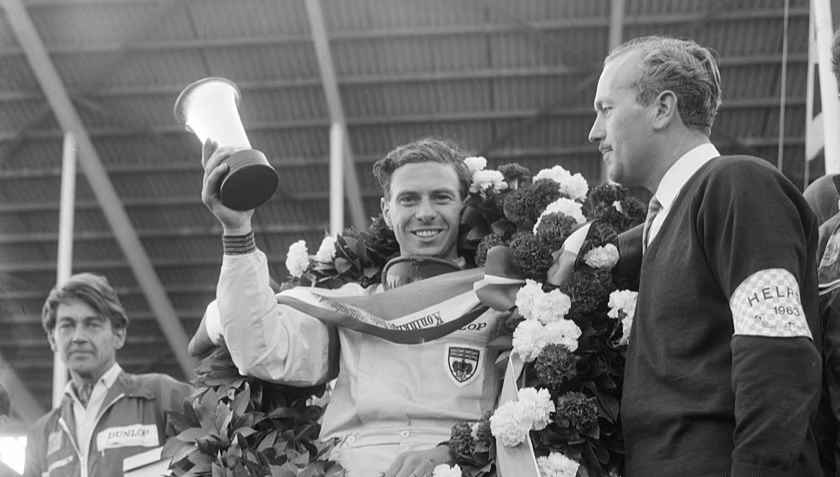
© Fotocollectie Anefo / Nationaal Archief - Jim Clark in his Lotus at the Dutch Grand Prix
Monza 1961: the terrible injustice
The relationship Clark had with Monza and Italy was complicated and painful. In 1961, he was the victim of an accident with Ferrari driver Wolfgang von Trips. He and 14 spectators would die. He was quickly designated as responsible for this tragedy, which would turn out to be false, but the tifosi would harbor a deep aversion toward him, which made him feel uneasy himself.
Everything would change in 1965, when Clark, dominating the F1 season in an insolent manner, started in the lead at Monza but was the victim of a puncture, losing a full lap on the race leaders. He undertook an astonishing solo comeback that would see him triumph on a circuit that favored drafting and pack racing. Moved by this feat, the Italian public would later rally to Jim Clark.

© Fotocollectie Anefo / Nationaal Archief - Jim Clark at the 1964 Dutch Grand Prix
Zandvoort 1967: the greatest?
During 1966, Clark reluctantly chose tax exile outside of Great Britain. The consequence of this decision was a ban on staying in the territory for a year. Clark lived in Paris that year, a city he loved deeply.
The new single-seater designed by Colin Chapman, the Lotus 49, made its debut in the spring of 1967 at Zandvoort, and Clark took it to victory in its very first appearance. But it should be known that, unable to go to England, all the testing for the 49 was conducted by Graham Hill. Clark discovered the car upon his arrival at the circuit and led it to victory without ever having driven it before, with disarming ease.