Article: Faites la course avec ce que vous avez apporté…
Faites la course avec ce que vous avez apporté…
Vincent Repoux · Dec 11, 2025
In other words: "run what you brung."
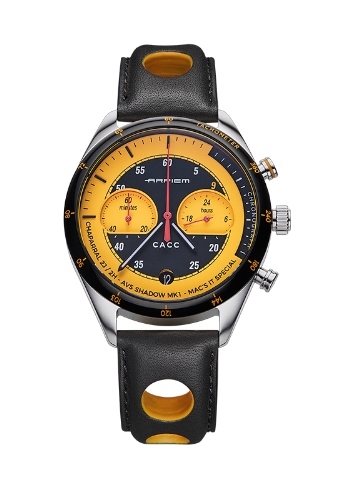
The wildest motor racing series ever organized, Can-Am, deserves to be known and talked about. Arpiem is dedicating one of its new chronographs to it, the Tribute CACC.
When it was created, the CAN-AM series benefited, at the behest of its promoters, from an extremely liberal set of regulations, intended to attract powerful and spectacular cars that could compete with Formula 1. Judge for yourself. These regulations were derived from the Group 7 rules established by the CSI (the ancestor of the FIA). Cars had to be two-seaters, have covered wheels, and possess a roll cage. And that was it! No restrictions on dimensions, on engine type, on displacement or the use of a turbo, and no minimum weight.
These regulations gave birth to some magnificent cars, such as the McLaren M8 series or the Porsche 917/30, the ultimate version of the Stuttgart icon that developed over 1,000 horsepower. The color of the CACC dial pays tribute to the legendary M8s. But these regulations also provided the opportunity to see the most extravagant and unlikely racing cars ever built. Their names appear at the bottom of the CACC dial. Here they are:
AVS SHADOW MK1
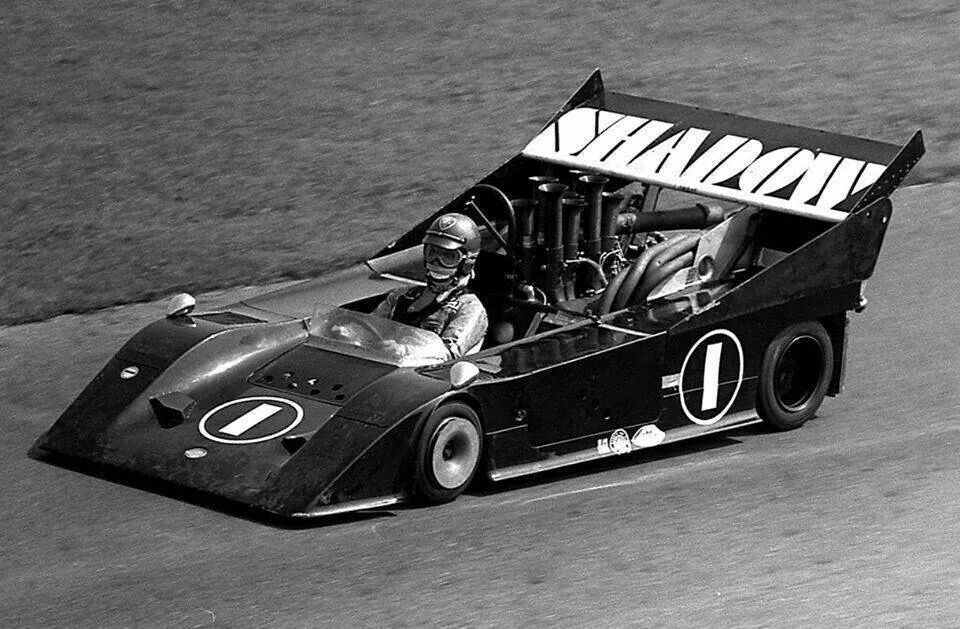
The first car produced by Don Nichols in 1969, he would go on to make a name for himself in the 70s in Formula 1 with his American team, Shadow. Nichols was an astonishing character: a former member of the US Air Force and the CIA, he made his fortune after the war in Japan by importing tires and automotive accessories. But that is not the point.
The stated goal with the MK1 was to produce the smallest possible car, equipped with the biggest possible engine, with the smallest possible frontal area.
What followed was a sort of giant go-kart, equipped with a 7-liter Chevy V8 producing 675 horsepower, whose chassis barely protected its driver, and which was fitted with 10-inch wheels at the front and 12-inch wheels at the rear. A monster.
George Follmer and Vic Elford were the brave drivers who took the wheel. Follmer famously said of it: "It’s the worst car I’ve ever driven. It’s a rocket in a straight line but it’s impossible to slow down (Editor's note: not very surprising: imagine the size of its brakes with that ridiculous wheel diameter) or keep on the road. It feels like it’s equipped with Model T Ford shocks."
MAC'S IT SPECIAL
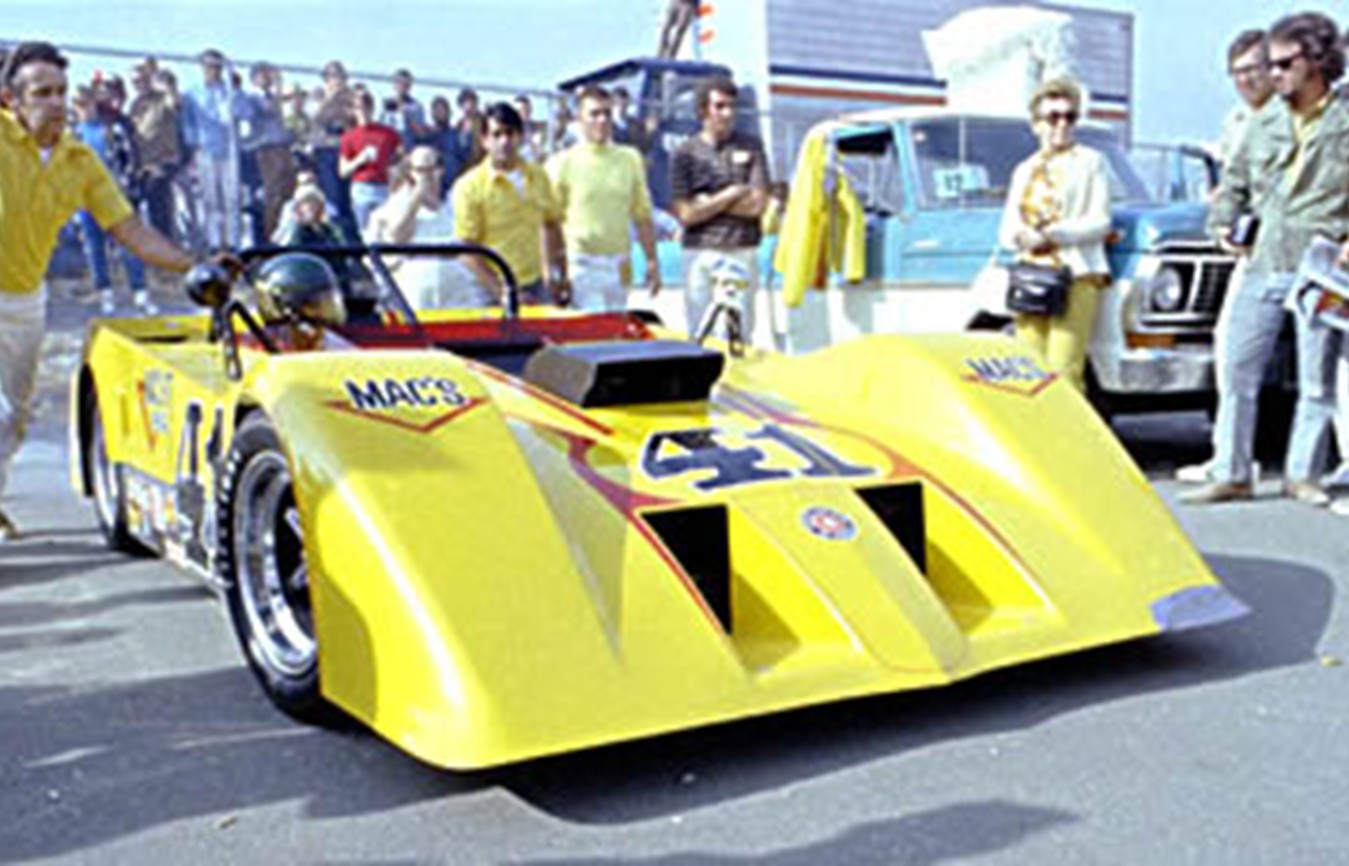
The Mac’s IT is even more extravagant: this car is equipped with four engines—775cc, 110-horsepower, 2-stroke ROTAX units—each powering a wheel while being linked to the others through a complex transmission system! How could anyone for a single second believe this would work? The car did run, however: it was presented at the 1970 Can-Am race at Laguna Seca. In practice, the fastest lap was set by a Chaparral 2J in 59 seconds. The Mac’s IT finished its best lap in 1 minute and 32 seconds… It was its only race appearance…
CHAPARRAL 2H
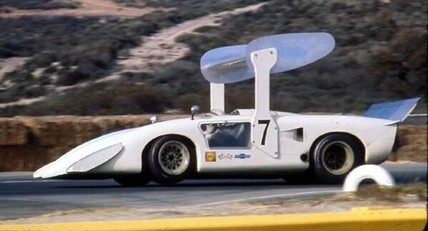
Not all unconventional ideas are necessarily doomed to failure. Much depends on who implements them. Jim Hall and his Chaparrals are the perfect illustration. Hall found the CAN-AM series to be the perfect playground to bring his avant-garde ideas to life. Years before anyone else, he was the first to understand the importance of aerodynamics and introduced wings, followed by ground effect (10 years before Lotus and Colin Chapman).
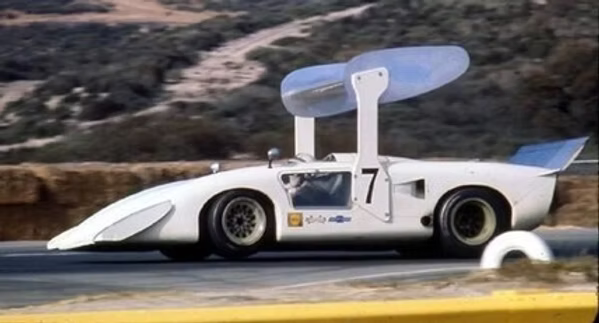
As early as 1965, Jim Hall equipped his cars with a movable wing. He entered the Can-Am Championship from its inception in 1966 with the 2C model, which featured this appendage. The concept would be pushed to its extreme in 1968 and 1969 with the 2H (see above), which was too radical and ultimately not a success. Accidents multiplied, particularly in F1 in 1969, because of these wings. The 2H was an airplane glued to the ground. At the slightest loss of downforce, it would take flight. Faced with the danger, regulators banned these movable wings from all competition.
CHAPARRAL 2J
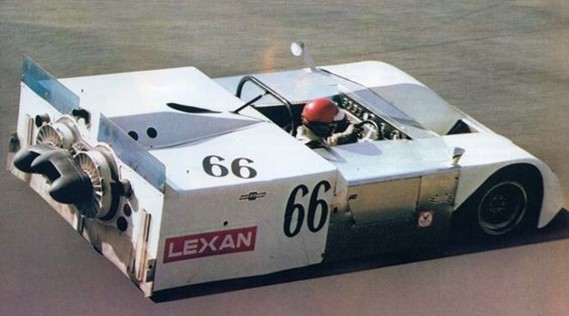
No matter. Jim Hall changed his tune while continuing to explore aerodynamics with the 2J model in 1970. A car that was more than surprising, looking for all the world like a shoebox to which the front end of a race car had been grafted... It couldn’t be uglier. But it was effective, even if it wasn't reliable.
In addition to its internal combustion engine, the 2J was equipped with two 2-stroke engines that powered two fans, which created a vacuum beneath the car, sticking it to the asphalt. And it worked. The 2J outclassed the McLarens in cornering speed, and in the qualifying sessions for the Riverside race, Vic Elford was two seconds a lap faster than the top McLaren. But the problem was that the fans sucked up and ejected behind the car, at bullet speed, any object or debris picked up on the track. Cars following the Chaparral risked puncturing their radiators at any moment, or worse, drivers risked taking these projectiles directly in the face. Once again, legislators could not stand by and banned the suction fans.
That was enough for Jim Hall, who threw in the towel. He still had the satisfaction of winning 3 Can-Am victories with his cars. He wouldn't be seen again until 10 years later, with the Chaparral 2K designed for the Indianapolis 500. Johnny Rutherford would win in it in 1980.
Hats off to Mr. Hall!