


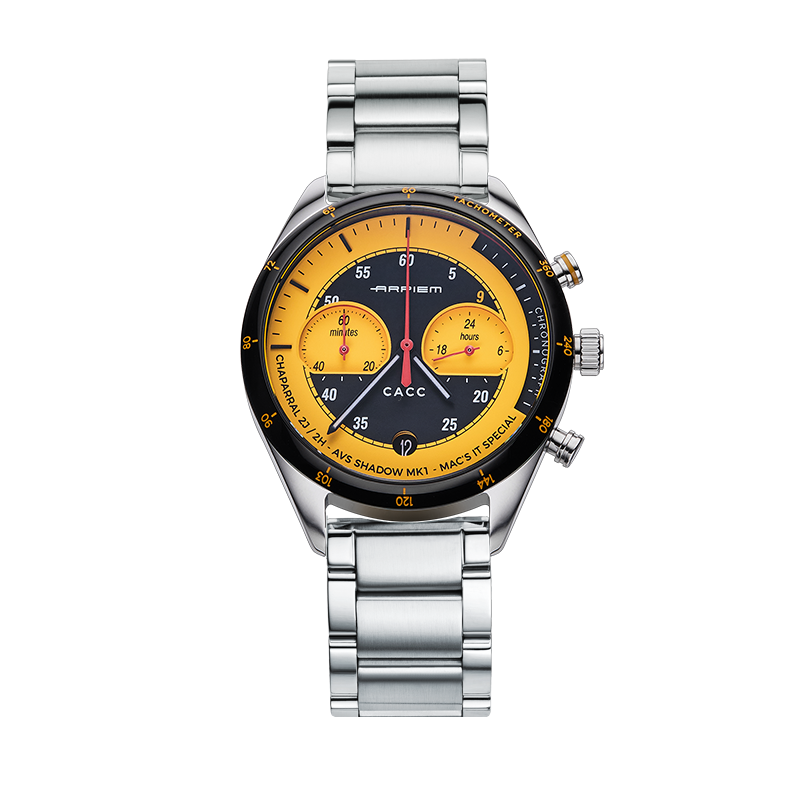
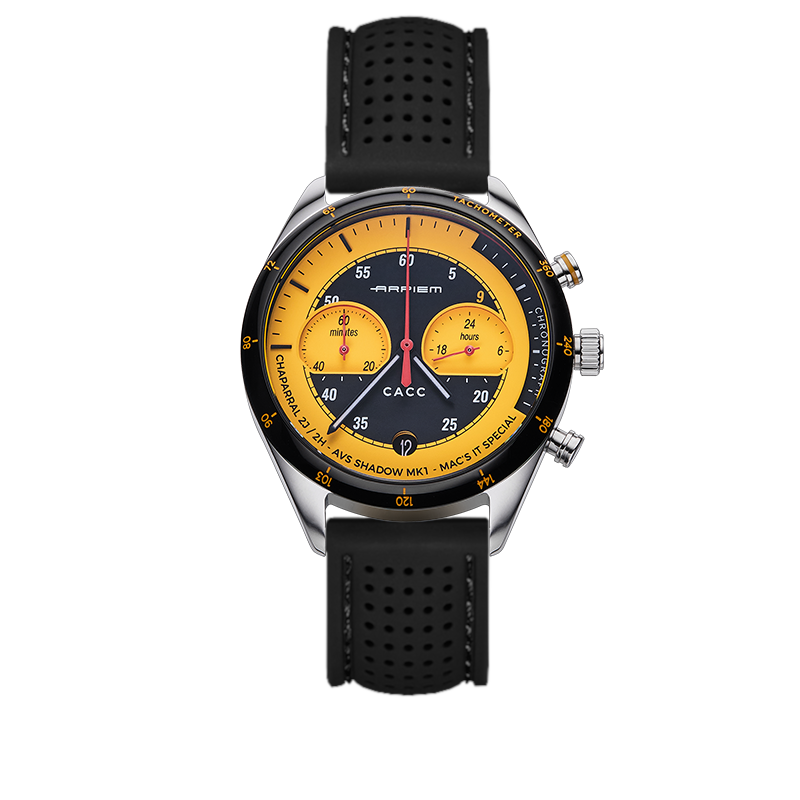
CACC Can-Am Tribute Chronograph
or 3 x €116,33 fee-free
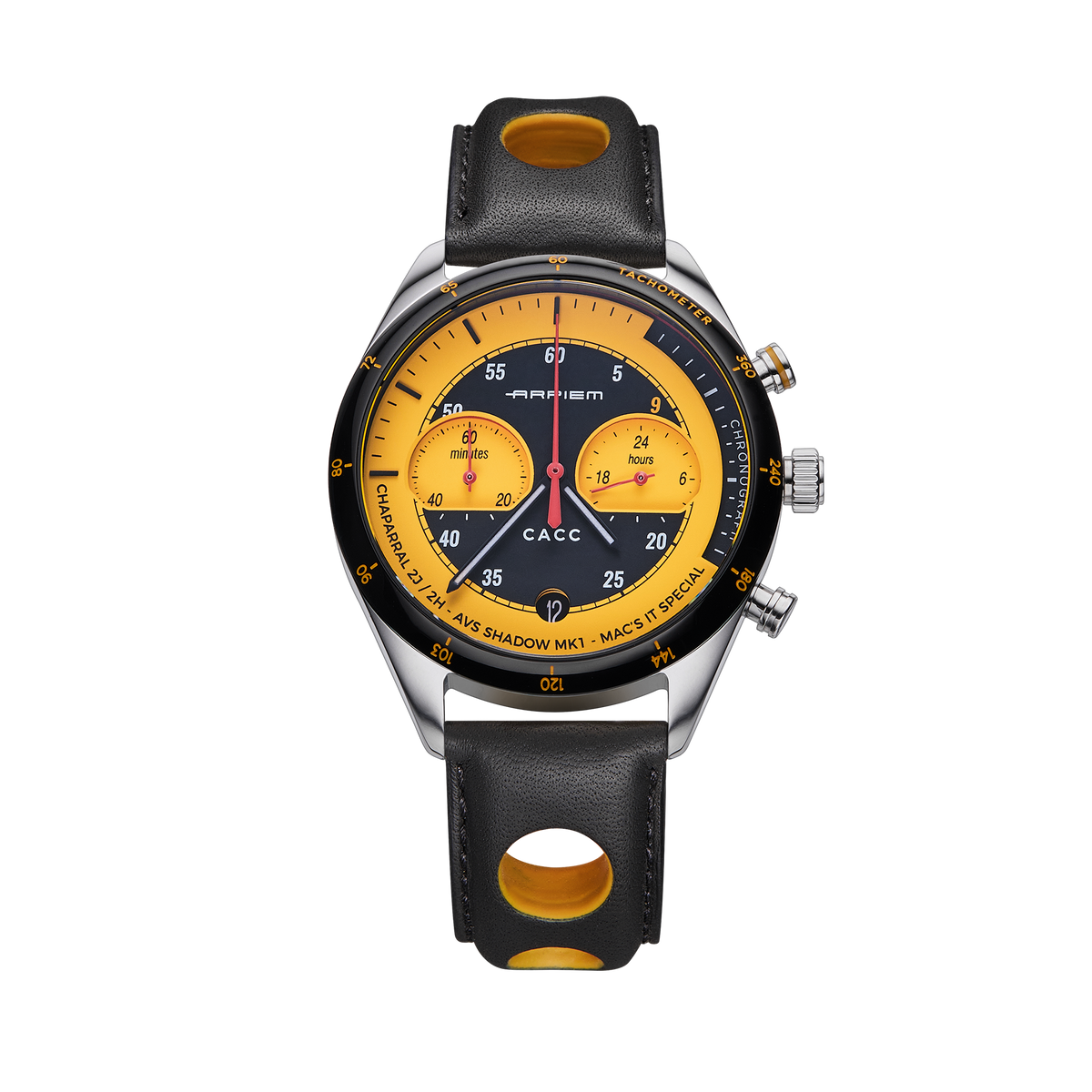
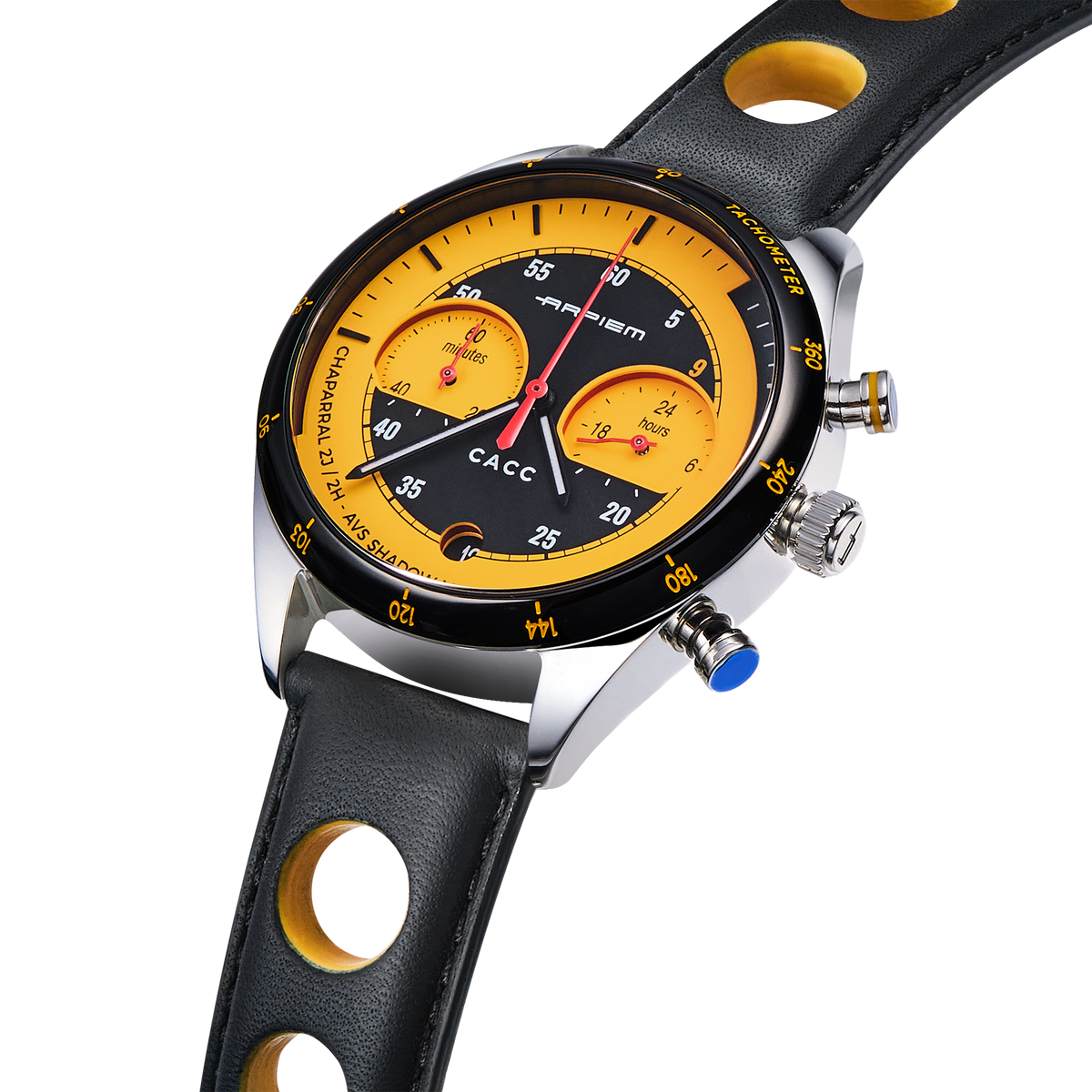
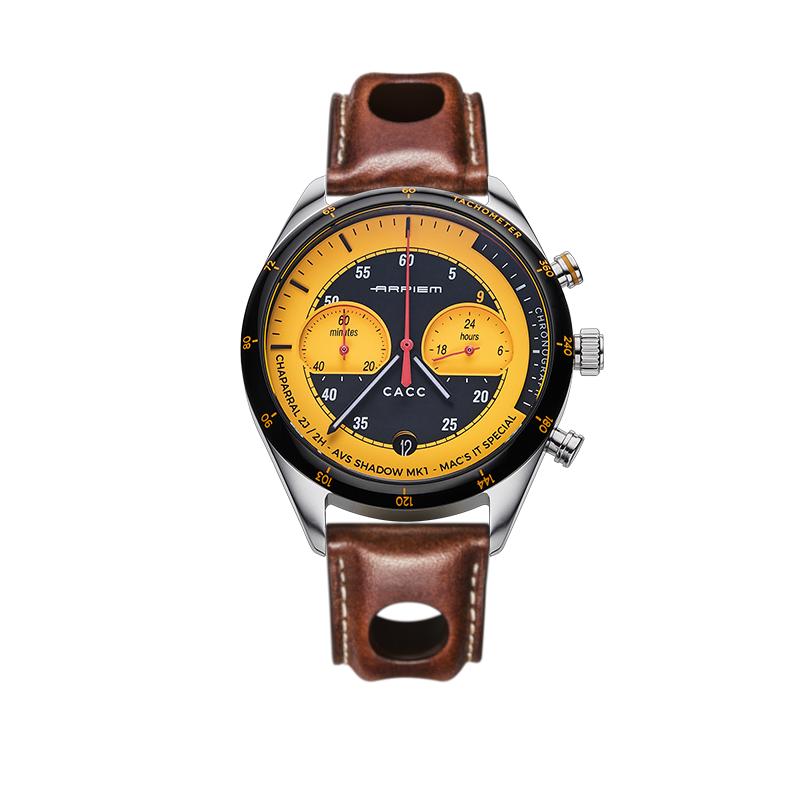
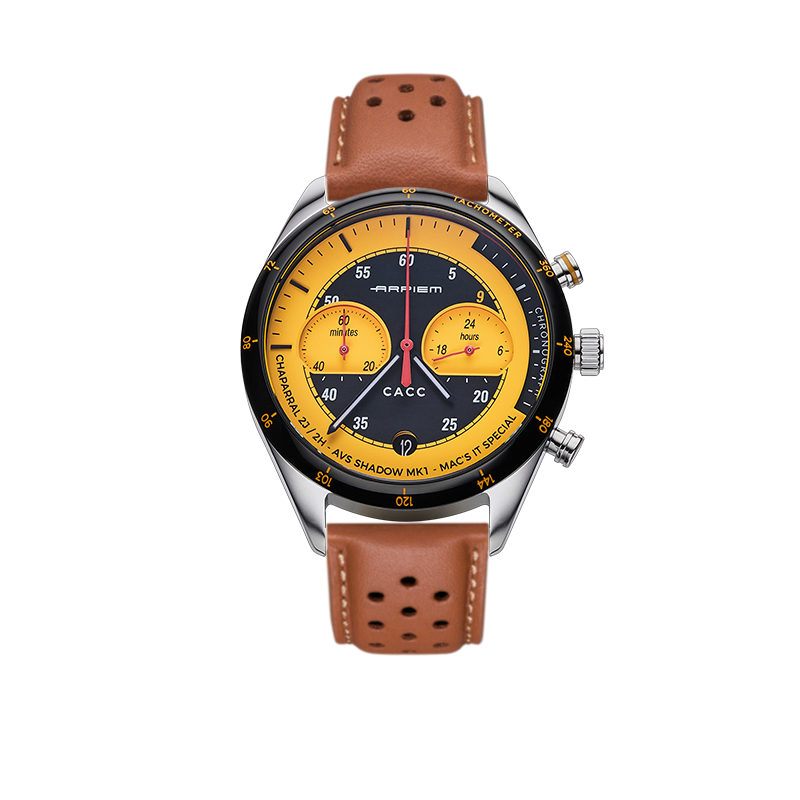
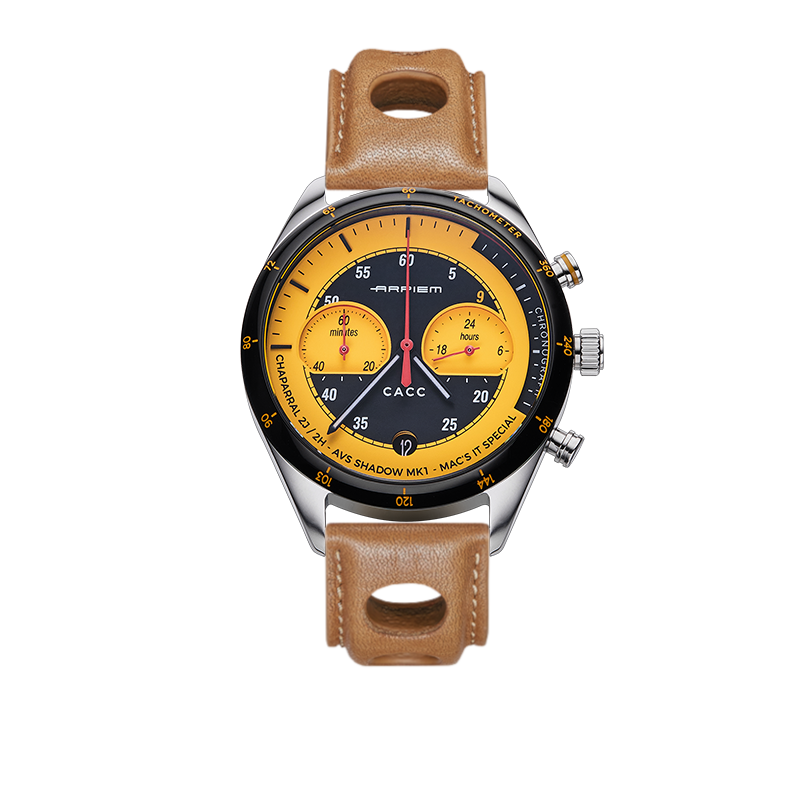
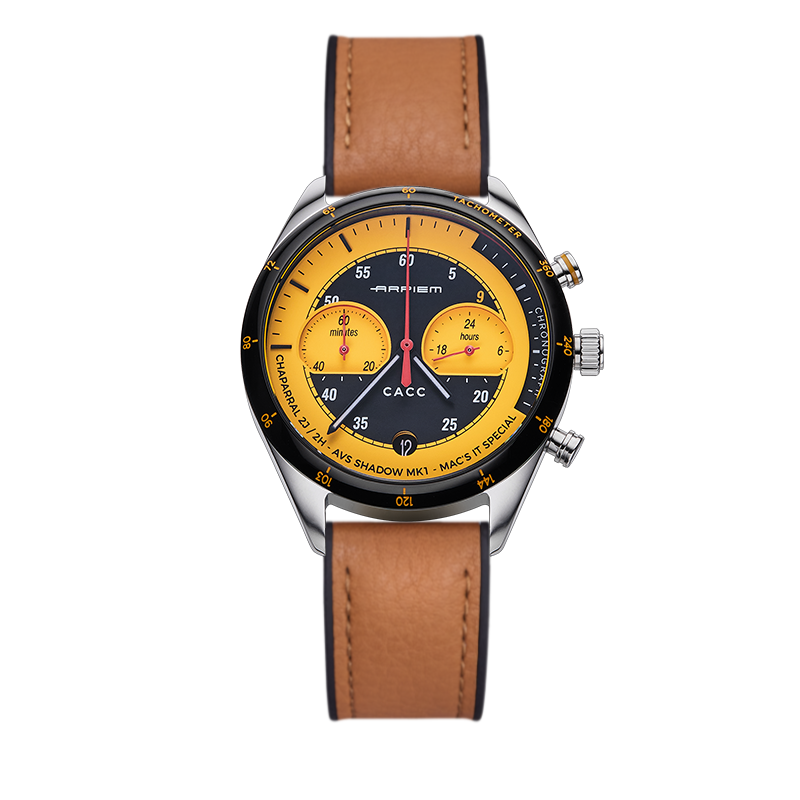
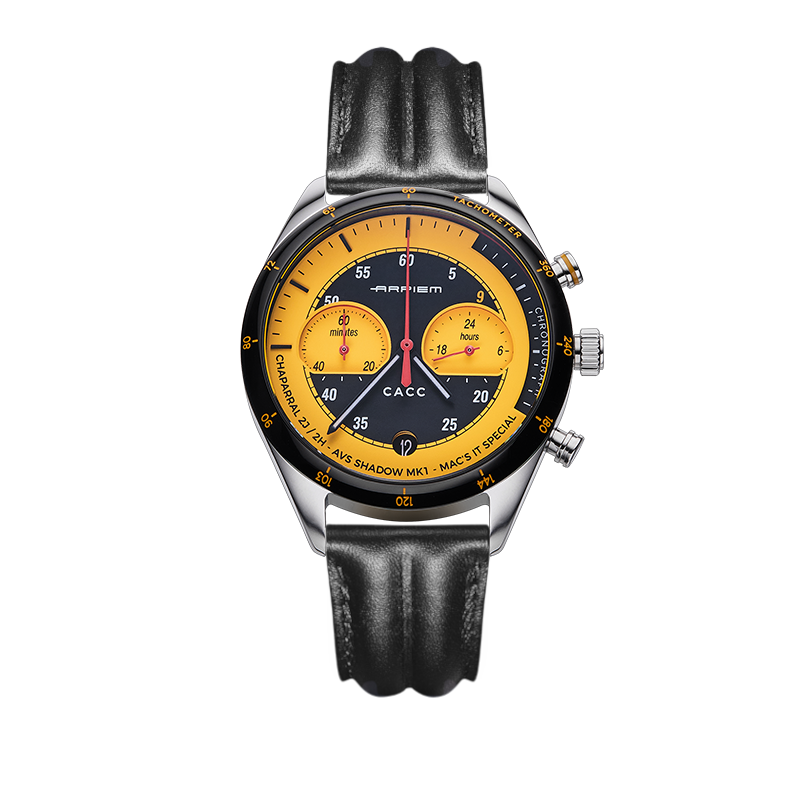
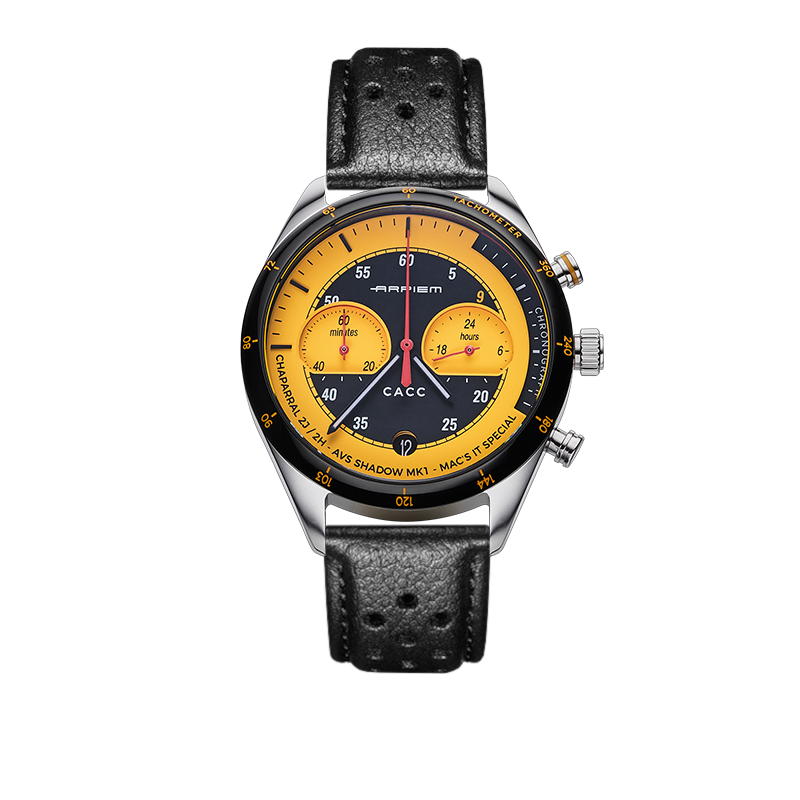
The ARPIEM Tribute is a men's chronograph with a "sporty," vintage, sophisticated, and elegant style. Its creator's passion for motorsports is linked above all to emotions: sounds, shapes, smells, and colors. These are the emotions he sought to capture in the Tribute watch collection, equipped with the TMI SEIKO VK64 hybrid Mecaquartz movement, which combines a quartz movement with a mechanical stopwatch.
30-day money-back guarantee
At its inception, the Can-Am series benefited from the desire of its promoters to have an extremely liberal set of regulations, with a view to fielding powerful and spectacular cars that could compete with Formula 1. Judge for yourself. These regulations were derived from the Group 7 rules established by the CSI (the ancestor of the FIA). The cars had to be two-seaters, have covered wheels, and possess a roll bar above the driver's head. And that was it! No restrictions on dimensions, engine type, displacement, or the use of a turbo, and no minimum weight.
These regulations gave birth to some magnificent cars, such as the McLaren M8 series or the Porsche 917/30, the ultimate version of the Stuttgart icon, which developed over 1,000 horsepower. The dial of the CACC features the legendary colors of the M8. But this regulation provided the opportunity to see the most extravagant and improbable racing cars ever built. Their names appear at the bottom of the CACC dial. Here they are:
AVS SHADOW MK1
The first car produced by Don Nichols in 1969, he would go on to make a name for himself in Formula 1 in the 70s with his American team, Shadow. Nichols was an astonishing character: a veteran of the U.S. Air Force who had worked for the CIA, he made his fortune after the war in Japan by importing tires and automotive accessories. But that is not the subject here.
The stated goal with the MK1 was to produce the smallest possible car, equipped with the largest possible engine, with the smallest possible frontal area.
What followed was a sort of giant Go-Kart, equipped with a 7-liter Chevy V8 engine and 675 horsepower, whose chassis barely protected its driver, fitted with 10-inch wheels at the front and 12-inch wheels at the rear. A monster (see photo in the CACC presentation carousel).
George Follmer and Vic Elford were the brave drivers who took the wheel. Follmer even declared about it: "It's the worst car I've ever driven. It's a rocket in a straight line, but it's impossible to slow down (Editor's note: not very surprising: imagine the size of its brakes with the ridiculous diameter of its wheels) or to keep it on the road. It feels like it's equipped with Ford Model T shock absorbers."
MAC’S IT SPECIAL
The Mac’s IT is even more extravagant: this car was equipped with 4 engines, 775 cc 110-horsepower 2-stroke ROTAX units, each driving a wheel while being linked to the others by a complex transmission system! How could anyone believe for a single second that it could work? The car did run, however: it was presented at the 1970 Can-Am race at Laguna Seca. During practice, the fastest lap was set by a Chaparral 2J in 59 seconds. The Mac’s IT completed its best lap in 1 minute 32 seconds… That was its only race appearance… (see photo in the CACC presentation carousel).
CHAPARRAL 2J and 2H
Not all unconventional ideas are doomed to failure. Much depends on who implements them. Jim Hall and his Chaparrals are the illustration of this. Hall found in Can-Am the perfect playground to bring his avant-garde ideas to life. He was the very first, years before everyone else, to understand the importance of aerodynamics and introduced wings and then ground effect (10 years before Lotus and Colin Chapman).
As early as 1965, Jim Hall equipped his cars with a mobile wing. He entered the Can-Am Championship from its inception in 1966 with a car, the 2C, equipped with this appendage. The concept would be pushed to its extreme in 1968 and 69 with the 2H, which, being too radical, was not a success (see photo in the CACC presentation carousel). Accidents multiplied, especially in F1, in 1969 because of these wings. The 2H was a plane glued to the ground. At the slightest loss of downforce, it would take flight. Faced with the danger, the regulators banned these mobile wings from all competition.
No matter. Jim Hall changed his approach while continuing to explore aerodynamics with the 2J model in 1970. A more than surprising car, looking suspiciously like a shoebox to which a racing car front end had been grafted… It couldn't be uglier. But it was effective, even if it was not reliable.
The 2J was equipped, in addition to its internal combustion engine, with 2 two-stroke engines that powered 2 fans which created a vacuum under the car, sticking it to the asphalt. And it worked. The 2J outperformed the McLarens in cornering speed, and in the qualifying sessions for the Riverside race, Vic Elford was two seconds a lap faster than the first McLaren. But the problem was that the fans sucked up and ejected whatever debris was on the track behind the car at the speed of a bullet. Cars following the Chaparral were at constant risk of puncturing their radiators, or worse, the drivers were hit by these projectiles. Once again, the legislators could not allow this and banned the suction fans (see photo in the CACC presentation carousel).
That was too much for Jim Hall, who threw in the towel. He still had the satisfaction of winning 3 CAN AM races with his cars. He would not be seen again until 10 years later, with the Chaparral 2K designed for the Indianapolis 500. Johnny Rutherford would win in it in 1980.
Hats off to Mr. Hall!
THE CASE of the ARPIEM Tribute is made of 316L stainless steel, synonymous with durability and solidity. It offers 10 ATM - 100 meters of water resistance.
THE DIAL: the shape of the sub-dials (the "pandas") is inspired by the pressure gauges of 1960s cars. The main dial indices represent the graduations of a tachometer.
THE MOVEMENT: the CACC is equipped with the TMI VK64 Mecaquartz movement. This unique hybrid movement offered by SEIKO combines an electric quartz movement for the watch and a mechanical chronograph.
THE DOMED SAPPHIRE CRYSTAL: this is the highest quality and strongest glass available on the market. Virtually scratch-proof (only by diamond), its domed finish gives the watch its "vintage" look.
THE TRIPLE-LAYER DIAL DESIGN gives the ARPIEM an elegant volume, which also recalls the "sandwich" alloy construction of racing car chassis before the advent of carbon fiber.
THE TACHYMETER: this has been revisited. Indices are usually arranged irregularly on the bezel. On the ARPIEM, they are placed like those on diving watches, with the speed given for each 5-second increment on the dial.
- Diameter = 41 mm
- Thickness = 12.9 mm
- Lug width = 20 mm
- TMI SEIKO VK64 mecaquartz hybrid movement
- 316L steel case developed by ARPIEM
- limited edition case numbering from 1 to 600
- Triple-layer dial
- Water resistance 10 ATM - 100 meters
- Domed sapphire crystal glass
- Date display at 6 o'clock
- Wooden presentation box
- Leather straps (calf or bull) with folding clasp (except SUZUKA strap) and quick-release system
- 2-year ARPIEM international warranty
Story
At its inception, the Can-Am series benefited from the desire of its promoters to have an extremely liberal set of regulations, with a view to fielding powerful and spectacular cars that could compete with Formula 1. Judge for yourself. These regulations were derived from the Group 7 rules established by the CSI (the ancestor of the FIA). The cars had to be two-seaters, have covered wheels, and possess a roll bar above the driver's head. And that was it! No restrictions on dimensions, engine type, displacement, or the use of a turbo, and no minimum weight.
These regulations gave birth to some magnificent cars, such as the McLaren M8 series or the Porsche 917/30, the ultimate version of the Stuttgart icon, which developed over 1,000 horsepower. The dial of the CACC features the legendary colors of the M8. But this regulation provided the opportunity to see the most extravagant and improbable racing cars ever built. Their names appear at the bottom of the CACC dial. Here they are:
AVS SHADOW MK1
The first car produced by Don Nichols in 1969, he would go on to make a name for himself in Formula 1 in the 70s with his American team, Shadow. Nichols was an astonishing character: a veteran of the U.S. Air Force who had worked for the CIA, he made his fortune after the war in Japan by importing tires and automotive accessories. But that is not the subject here.
The stated goal with the MK1 was to produce the smallest possible car, equipped with the largest possible engine, with the smallest possible frontal area.
What followed was a sort of giant Go-Kart, equipped with a 7-liter Chevy V8 engine and 675 horsepower, whose chassis barely protected its driver, fitted with 10-inch wheels at the front and 12-inch wheels at the rear. A monster (see photo in the CACC presentation carousel).
George Follmer and Vic Elford were the brave drivers who took the wheel. Follmer even declared about it: "It's the worst car I've ever driven. It's a rocket in a straight line, but it's impossible to slow down (Editor's note: not very surprising: imagine the size of its brakes with the ridiculous diameter of its wheels) or to keep it on the road. It feels like it's equipped with Ford Model T shock absorbers."
MAC’S IT SPECIAL
The Mac’s IT is even more extravagant: this car was equipped with 4 engines, 775 cc 110-horsepower 2-stroke ROTAX units, each driving a wheel while being linked to the others by a complex transmission system! How could anyone believe for a single second that it could work? The car did run, however: it was presented at the 1970 Can-Am race at Laguna Seca. During practice, the fastest lap was set by a Chaparral 2J in 59 seconds. The Mac’s IT completed its best lap in 1 minute 32 seconds… That was its only race appearance… (see photo in the CACC presentation carousel).
CHAPARRAL 2J and 2H
Not all unconventional ideas are doomed to failure. Much depends on who implements them. Jim Hall and his Chaparrals are the illustration of this. Hall found in Can-Am the perfect playground to bring his avant-garde ideas to life. He was the very first, years before everyone else, to understand the importance of aerodynamics and introduced wings and then ground effect (10 years before Lotus and Colin Chapman).
As early as 1965, Jim Hall equipped his cars with a mobile wing. He entered the Can-Am Championship from its inception in 1966 with a car, the 2C, equipped with this appendage. The concept would be pushed to its extreme in 1968 and 69 with the 2H, which, being too radical, was not a success (see photo in the CACC presentation carousel). Accidents multiplied, especially in F1, in 1969 because of these wings. The 2H was a plane glued to the ground. At the slightest loss of downforce, it would take flight. Faced with the danger, the regulators banned these mobile wings from all competition.
No matter. Jim Hall changed his approach while continuing to explore aerodynamics with the 2J model in 1970. A more than surprising car, looking suspiciously like a shoebox to which a racing car front end had been grafted… It couldn't be uglier. But it was effective, even if it was not reliable.
The 2J was equipped, in addition to its internal combustion engine, with 2 two-stroke engines that powered 2 fans which created a vacuum under the car, sticking it to the asphalt. And it worked. The 2J outperformed the McLarens in cornering speed, and in the qualifying sessions for the Riverside race, Vic Elford was two seconds a lap faster than the first McLaren. But the problem was that the fans sucked up and ejected whatever debris was on the track behind the car at the speed of a bullet. Cars following the Chaparral were at constant risk of puncturing their radiators, or worse, the drivers were hit by these projectiles. Once again, the legislators could not allow this and banned the suction fans (see photo in the CACC presentation carousel).
That was too much for Jim Hall, who threw in the towel. He still had the satisfaction of winning 3 CAN AM races with his cars. He would not be seen again until 10 years later, with the Chaparral 2K designed for the Indianapolis 500. Johnny Rutherford would win in it in 1980.
Hats off to Mr. Hall!
Description
THE CASE of the ARPIEM Tribute is made of 316L stainless steel, synonymous with durability and solidity. It offers 10 ATM - 100 meters of water resistance.
THE DIAL: the shape of the sub-dials (the "pandas") is inspired by the pressure gauges of 1960s cars. The main dial indices represent the graduations of a tachometer.
THE MOVEMENT: the CACC is equipped with the TMI VK64 Mecaquartz movement. This unique hybrid movement offered by SEIKO combines an electric quartz movement for the watch and a mechanical chronograph.
THE DOMED SAPPHIRE CRYSTAL: this is the highest quality and strongest glass available on the market. Virtually scratch-proof (only by diamond), its domed finish gives the watch its "vintage" look.
THE TRIPLE-LAYER DIAL DESIGN gives the ARPIEM an elegant volume, which also recalls the "sandwich" alloy construction of racing car chassis before the advent of carbon fiber.
THE TACHYMETER: this has been revisited. Indices are usually arranged irregularly on the bezel. On the ARPIEM, they are placed like those on diving watches, with the speed given for each 5-second increment on the dial.
Characteristics
- Diameter = 41 mm
- Thickness = 12.9 mm
- Lug width = 20 mm
- TMI SEIKO VK64 mecaquartz hybrid movement
- 316L steel case developed by ARPIEM
- limited edition case numbering from 1 to 600
- Triple-layer dial
- Water resistance 10 ATM - 100 meters
- Domed sapphire crystal glass
- Date display at 6 o'clock
- Wooden presentation box
- Leather straps (calf or bull) with folding clasp (except SUZUKA strap) and quick-release system
- 2-year ARPIEM international warranty
Choose options
Free delivery
In France and the euro area
Free returns
Within 30 days in France
Customer service
07 56 43 41 86
Installment payment
3 to 4 installments at no extra cost
Stay informed
Newsletter
New arrivals, limited editions, and priority access to upcoming collections. Delivered straight to your inbox.