For a long time, the glory of French endurance racing was shared between the Sarthe and Champagne regions. For Le Mans was not the only guardian of the temple. A few kilometers from the cathedral of coronations, the Reims-Gueux circuit offered another liturgy: that of speed. Three discreet villages—Gueux, Muizon, and Thillois—traced a simple triangle of asphalt. A combination of departmental and national roads, nothing that seemed destined to enter legend. And yet, this track would become one of the most feared and respected in the history of motorsport.
Inaugurated in 1926, the circuit was unassuming: 8.3 kilometers formed by three long straights, punctuated by treacherous corners with evocative names: Gueux, Thillois, Muizon. Three public roads repainted for racing, bordered by thousands of spectators massed as close to the asphalt as possible. It was that same year that the first 12 Hours of Reims appeared, organized regularly during the interwar period. The Second World War interrupted this momentum, but the post-1950 revival marked the heyday of Reims-Gueux, driven by the arrival of the major manufacturers: Mercedes, Jaguar, Ferrari, and Ford.
The 12 Hours: Le Mans' revenge
On July 4, 1953, at noon, the Jaguar C-Types set off for the first modern edition of the 12 Hours of Reims. This race, shifted in time—from noon to midnight—quickly forged a reputation: that of a "Le Mans revenge," organized two weeks after the 24 Hours, offering the unlucky teams a second opportunity to shine. Stirling Moss and Peter Whitehead dominated the 1953 edition before Jaguar crushed the competition the following year with a historic hat-trick by its D-Types.
Between 1953 and 1967, the 12 Hours left a lasting mark on French endurance racing. In 1964, the event became part of the World Sportscar Championship. Ford entered three GT40s, determined to erase its disappointment at Le Mans, but all three cars retired early. Victory went to Graham Hill and Joakim Bonnier in a Ferrari 250 LM, after 296 laps—a symbolic revenge for the Italian brand. This edition was also marked by the spectacular accident of Jean-Pierre Beltoise, who was thrown more than 50 meters and spent two days in a coma. For the 12 Hours also had their dark side: on June 30, 1956, Annie Bousquet, one of the best French female drivers, lost her life at the Muizon corner.
The final edition, in 1967, saw Jo Schlesser and Guy Ligier win in a Ford GT40 Mk IIB. The only Ford victory in the event.
Reims-Gueux, at the origins of modern Formula 1
In the post-war period, Reims-Gueux also became a mecca for Formula 1. The circuit is inseparable from the career of a certain Juan Manuel Fangio, who won three times (1950, 1951, 1954). In 1954, he became the first driver to break the symbolic 200 km/h barrier in practice behind the wheel of the Mercedes W196. On July 6, 1958, Mike Hawthorn made history by setting the first race average speed of over 200 km/h. That same day, 47-year-old Fangio drove his final race behind the wheel of an aging Maserati and retired from competition.
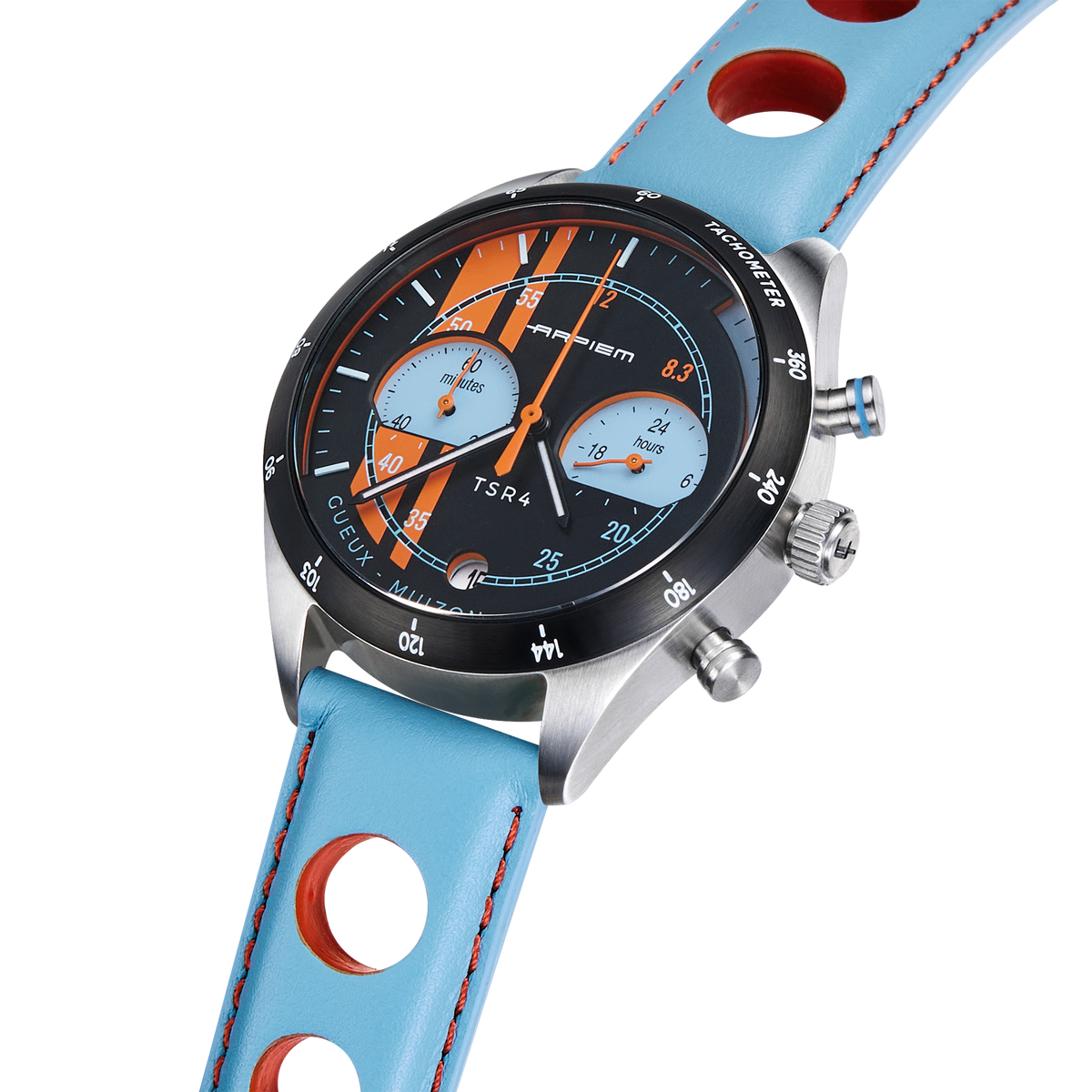
The last races took place in 1972. Today, volunteers are working to restore the grandstands, the brightly colored pits, and the restaurant tower. In 2009, the circuit was officially classified as a historical monument. As its centenary approaches in 2026,
Arpiem wanted to pay tribute to this mythical place of speed through its new TSR4. On the dial, you will find the "12" index highlighted in reference to the 12-hour race, the 8.3 index corresponding to the length of the track, and at the bottom of the dial, its famous 3 corners: Gueux, Muizon, and Thillois. Engraved on the back of the watch is the track layout.